Currently Empty: R0.00

Water Treatment System Specifications Explained: A Buyer’s Guide
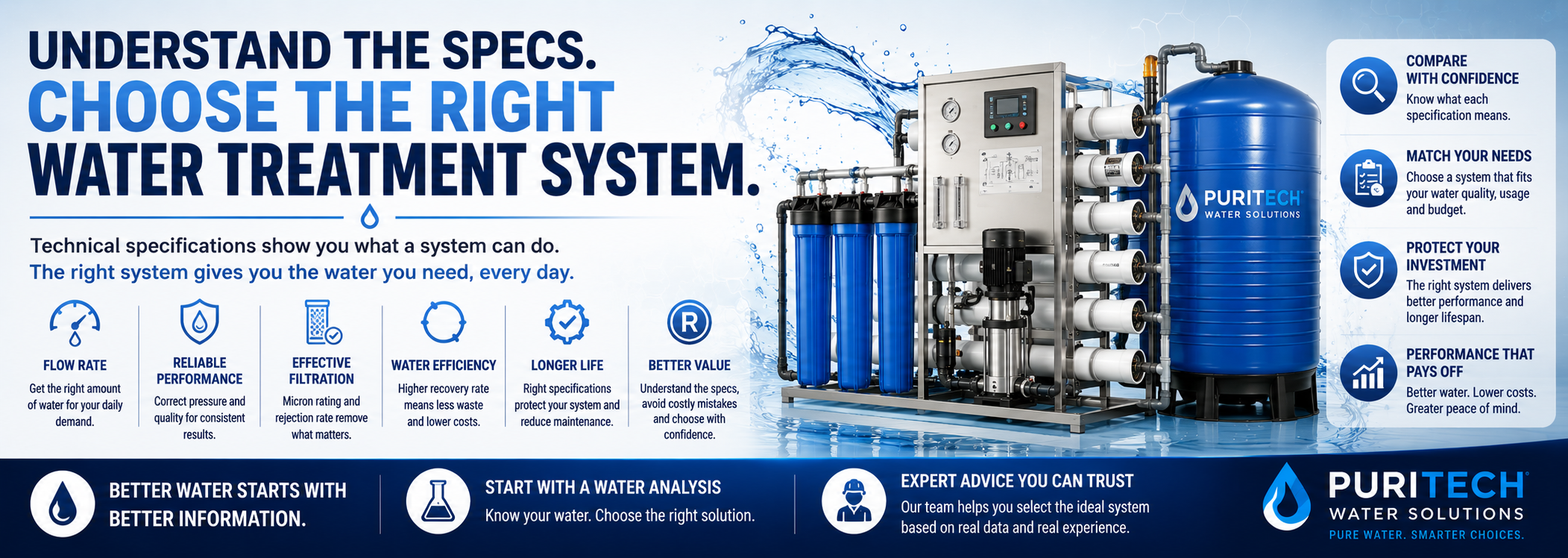
Buying a water treatment system is a significant investment, whether it is for your home, business, or industrial facility. Unfortunately, many buyers compare systems based only on price, without understanding the technical specifications that determine how well a system will perform.
Understanding water treatment system specifications allows you to compare products accurately and choose a system that meets your water quality requirements, daily demand and operating conditions. It also helps you avoid purchasing equipment that is undersized, oversized, or unsuitable for your application.
This guide explains the most important specifications you should understand before investing in a water treatment system.
Why Technical Specifications Matter
Technical specifications describe the operating capabilities and limitations of a water treatment system.
They help answer important questions such as:
- Can the system produce enough water?
- Will it work with my available water pressure?
- Is it suitable for my water quality?
- How often will filters need replacing?
- How much electricity will it use?
- Can it support my household or business?
Without understanding these specifications, choosing the right system becomes little more than guesswork.
Flow Rate
‘Flow rate’ refers to the amount of water a system can produce over a specific period.
It is usually expressed as:
- Litres per minute (L/min)
- Litres per hour (L/h)
- Cubic metres per hour (m³/h)
A system with a high filtration quality but a low flow rate may not keep up with your daily water demand.
For example:
- A household may require only a modest flow rate for normal daily use.
- A restaurant or factory typically requires a much higher flow rate to maintain uninterrupted operations.
Choosing the correct flow rate ensures that water is available whenever it is needed.
Operating Pressure
Every water treatment system is designed to operate within a specific pressure range.
If water pressure is too low:
- Performance may decrease.
- Reverse osmosis production may slow down.
- Equipment may not operate correctly.
If pressure is too high:
- Components may wear prematurely.
- Pipework and fittings experience additional stress.
- Safety devices may activate.
Where necessary, booster pumps or pressure-reducing valves help maintain the correct operating pressure.
Daily Production Capacity
Many reverse osmosis systems are rated according to the amount of purified water they can produce in one day.
This capacity is commonly expressed as:
- Gallons per day (GPD)
- Litres per day (L/day)
For example, a 2,000 GPD reverse osmosis system produces significantly more water than a 400 GPD system.
Selecting the correct production capacity ensures that your daily water demand is met without overloading the equipment.
Micron Rating
The micron rating indicates the size of the particles a filter can remove.
A micron is one-millionth of a metre.
Common examples include:
- 20 micron – larger sediment
- 5-micron – sand and fine particles
- 1 micron – finer suspended solids
- 0.1 micron – ultrafiltration membranes
A lower micron rating removes smaller particles. However, a finer filter is not always the best choice. The correct micron rating depends on your water quality and the contaminants you need to remove.
Filter Capacity
Every filter cartridge has a maximum treatment capacity before it requires replacement.
Capacity depends on factors such as:
- Water quality
- Daily usage
- Sediment levels
- Chlorine concentration
Understanding filter capacity helps you estimate maintenance intervals and operating costs.
Maximum Feed Water Quality
Some treatment systems are designed to process only municipal water, while others can treat borehole water, surface water or higher levels of dissolved minerals.
Manufacturers often specify:
- Maximum TDS
- Maximum turbidity
- Maximum iron concentration
- Maximum manganese concentration
- Acceptable pH range
A professional water analysis ensures the selected system is compatible with your water source.
Operating Temperature
Water treatment equipment also has recommended operating temperature limits.
Extremely hot or freezing water may affect:
- Filter performance
- Membrane life
- Pump efficiency
- Plastic components
Installing equipment within its specified operating range helps maximise reliability and lifespan.
Recovery Rate
One of the most important specifications for reverse osmosis systems is the recovery rate.
The recovery rate indicates the percentage of incoming water that is converted into purified water.
For example:
- A 50% recovery rate means that half of the incoming water becomes purified water, while the remaining portion is discharged as concentrate.
- Larger commercial and industrial systems often achieve higher recovery rates through careful system design and additional treatment stages.
A properly designed recovery rate helps maximise water efficiency while protecting the reverse osmosis membranes from excessive fouling and scaling.
Rejection Rate
The rejection rate measures how effectively a reverse osmosis membrane removes dissolved contaminants.
It is usually expressed as a percentage.
A higher rejection rate generally means better removal of:
- Dissolved salts
- Heavy metals
- Nitrates
- Fluoride
- Other dissolved impurities
Understanding the rejection rate helps you evaluate the quality of the treated water rather than focusing only on production capacity.
Power Consumption
Some water treatment systems require electrical power to operate pumps, UV disinfection units or control systems.
Manufacturers typically specify:
- Voltage
- Power rating
- Frequency
Power consumption becomes particularly important for:
- Large commercial installations
- Industrial facilities
- Municipal backup systems
- Off-grid applications
Selecting an energy-efficient system can reduce long-term operating costs.
Pipe Connection Sizes
Pipe connection sizes determine how the system connects to your existing plumbing.
Incorrect pipe sizing can reduce performance and complicate installation.
Typical connection sizes vary depending on the application, from residential systems to large industrial installations.
A professional installer will ensure the pipework matches both the treatment system and your property’s water demand.
Service Intervals
Every water treatment system requires routine maintenance.
Manufacturers often specify recommended service intervals for:
- Sediment filters
- Activated carbon filters
- Reverse osmosis membranes
- UV lamps
- Pumps
- Valves
Following these maintenance schedules helps maintain performance, improve water quality and extend equipment lifespan.
Replacement Parts Availability
When comparing water treatment systems, don’t focus only on the purchase price.
Also consider:
- Availability of replacement filters
- Availability of membranes
- Pump spare parts
- Technical support
- Local service providers
Choosing a system with readily available replacement parts helps minimise downtime and simplifies future maintenance.
Warranty
A warranty demonstrates the manufacturer’s confidence in its product.
Before purchasing, check:
- Warranty period
- Components covered
- Installation requirements
- Maintenance conditions
- Warranty exclusions
Remember that regular servicing is often required to keep the warranty valid.
Certifications
Quality certifications provide additional confidence that equipment has been manufactured and tested to recognised standards.
Depending on the product, certifications may relate to:
- Product quality
- Material safety
- Drinking water applications
- Manufacturing quality systems
Although certifications are valuable, they should always be considered alongside system design, water quality and the supplier’s technical expertise.
Never Buy Without a Water Analysis
Even the highest-quality water treatment system cannot perform correctly if it is selected for the wrong water conditions.
A professional water analysis identifies:
- Water hardness
- Iron
- Manganese
- pH
- Total Dissolved Solids (TDS)
- Turbidity
- Conductivity
- Other water quality parameters
These results enable the correct system to be selected based on actual water conditions rather than assumptions.
Frequently Asked Questions
Do I need to understand every technical specification?
No. However, understanding the key specifications helps you compare systems more confidently and ask the right questions before making a purchase.
Is a larger system always better?
Not necessarily. An oversized system may increase installation and operating costs, while an undersized system may struggle to meet your daily water demand. The ideal system matches your specific application.
Why is flow rate important?
Flow rate determines how much treated water the system can deliver. A system with insufficient flow may not meet your household or business requirements during peak demand.
Can two systems look the same but perform differently?
Yes. Two systems may appear almost identical, yet differ significantly in flow rate, membrane quality, operating pressure, recovery rate, filtration performance and overall durability.
Conclusion
Understanding water treatment system specifications is one of the best ways to make an informed purchasing decision. While price is an important consideration, it should never be the only factor. Specifications such as flow rate, operating pressure, production capacity, micron rating, recovery rate and maintenance requirements all determine how well a system will perform over its lifetime.
By combining a professional water analysis with expert guidance, you can choose a system that matches your water quality, daily usage and future requirements. This approach not only improves performance but also reduces maintenance costs, extends equipment life and provides greater value for your investment.
At Puritech, we help customers understand the technical specifications behind every water treatment system, ensuring they invest in a solution that delivers reliable performance for years to come.